

Love is Impossible
(Im)Practical Steps to a Better Marriage

Justin and I are teaching. We’re on a stage in a church gym. Couples sit at white circle tables as we wonder aloud about what it takes to love each other. We’ve been off script for a solid six minutes. Nothing we’re saying is in our notes.
Justin surprises me as he says, “Love is walking on water.”
Mmm. I nod. That’s it—
Love is an impossible thing. A wonder. The apostle Paul calls it a supernatural gift (I Cor. 13) and a mystery that surpasses knowledge (Eph. 3). But of course it’s also the blood in the veins of any child of God. It’s the air we breathe. It’s our mother tongue. Love is a miracle, and love is the silver spoon with which we eat our Cheerios.
Justin asks the audience, “So how do you do it? How do you walk on water?”
And I realize my turn to talk is coming. Do I have an answer?
-
It was the morning before the marriage event, and we were going over our notes. Everything looked good, but the first session, the first of five, didn’t feel right. First sessions are notoriously difficult. You have to explain the theme, build tension, promise a resolution, and otherwise convince everyone to come back for more while also offering some actual meat.
We’d planned to talk about the concept of genre, that the kind of story you’re reading should clue you in to what’s coming.
If marriage is a love story, what should you expect?
But we had concerns about modern love stories and their cotton candy baggage. Justin said, “Marriage is definitely not supposed to be a Colleen Hoover novel.” He shook his head. “Or a Hallmark movie!”
So we decided we’d start with God’s love for His bride, first Israel, then the church. We’d explain how our little love stories grow out of (and testify to) the greater love story.
We jotted down new notes…
The part I still didn’t like was our definition of love. We’d been using it for years (borrowed it from a theologian we admired), but lately it didn’t feel right. I couldn’t figure out why I didn’t like it, so I asked Justin to look again and tell me what he thought. He re-read the definition he’d read a hundred times:
“Love is a rugged commitment to be with someone and for someone toward God’s will for that someone.”
“Huh,” he said. “Yeah…’
It wasn’t that the definition was wrong, per se. That is exactly what love looks like. As a diagnostic, the definition works perfectly. But as advice? It makes love look like yet another something to earn. A skill to master. A goal to strive for.
Be ruggedly committed.
Be with someone.
Be for someone.
Make God’s will for that someone your North Star.
Muster, Try, Do
As we talked we realized we wanted to say something different, something more like…
God is ruggedly committed to you (a gift!), and that commitment offers you security, grace, and peace. Because He loves you, you can offer that same faithful love to someone else.
God is with you (a grace!); His constant presence means you’re never alone. Because He’s with you, you can bravely offer yourself to someone else, unafraid of rejection.
God is for you (a wonder!). He is your Helper, Comforter, Savior. What you need, He offers—in part, so you’re equipped to be for someone else.
And God is loving you toward the goal of your glorification. Love pulls you deeper and deeper into the fullness of Christ. We are drowned in love. We are washed in love. We are reborn in love, remade in love. We abide in love forever…
God’s love is a spring inside you. No matter how much you pour out, He’ll fill you up.
Then Justin said, “But we can’t just leave it at Love is a gift. They’re heard that before and they don’t know what it means.”
-
“How do you walk on water?”
I take a breath, lift my microphone to speak, and before I can stumble into an answer, Justin is talking again. His answer is better than mine.
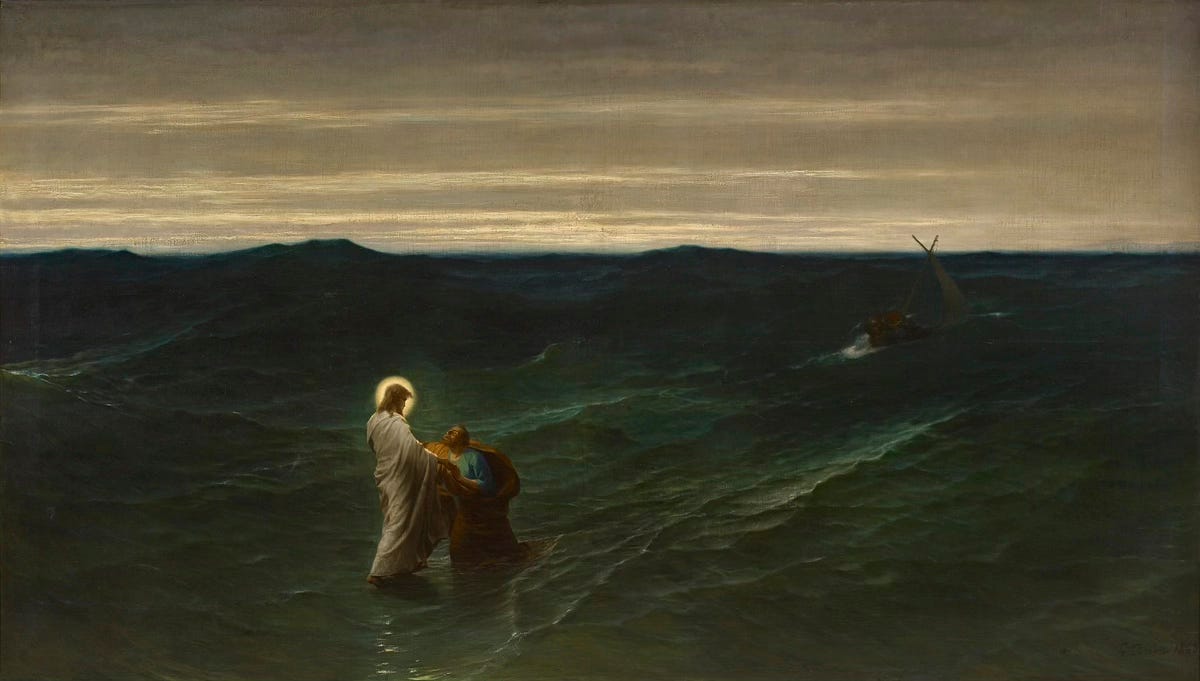
He says, “I don’t know how. You just step out and do it.
…Peter got out of the boat and he walked on water.”
-
Justin and I ordered Pai Thai for lunch. The driver got lost; while we waited for him to figure out the location of our in-the-woods Airbnb, we continued to prep for the marriage event, still searching for a way to describe a mystery. We talked about the “rugged commitment” language in our definition, about how for a long time we thought staying married was about striving and straining to reach the goal of commitment when all along commitment was a gift to receive.
I said, “I can’t explain it, but commitment is the gift and commitment summons the gift. Right?
It is the gift, because commitment invites me to practice loyalty and loyalty results in beautiful fruit: trust, hope, grace. Because we’re committed to one another, we’re safe together. It’s like a forcefield.
But it’s also like commitment draws me out into the enchanted world where the gift lives. It’s this wild impossible thing that requires power I don’t have. If I’m going to love one man my whole life, I’m going to need supernatural assistance. And that can be overwhelming and hard to get my head around in principle. But in practice—it’s like, you just…
It’s like how God says there won’t be a temptation you can’t bear, and maybe you believe that or maybe you don’t, but then you find yourself in the moment, tempted and feeling like you can’t say no, but you pray and somehow, you can say no. God just makes it possible.
It’s like that. I don’t know how we do love—the logistics of wielding the superpower—I just know that when I need it, and when I’m willing to try it, it’s here and it works.”
-
It’s my time to speak now. I go back to the passage I read a moment ago, before Justin started talking about walking on water. I read it again:
“I pray that you, being rooted and firmly established in love, may be able to comprehend with all the saints what is the length and width, height and depth of God’s love, and to know Christ’s love that surpasses knowledge, so that you may be filled with all the fullness of God” (Eph. 3: 17-19).
How do we walk on water?
I say, “If you are filled with the fullness of God, love is a spring inside you…”
We walk on water because it’s what He did. We walk on water because that’s what we do (even if we don’t understand quite how). We walk on water, we love, because it’s our destiny, our purpose, the music of what happens when we get out of the way and let the spring bubble and gush and spill.
-JL
The Storied Marriage
If you’re interested in having Justin and I bring The Storied Marriage to your church, nonprofit, or school reply to this email, and I’ll get you all the details. We’ve incorporated this set of messages, conversations, and exercises into retreat weekends or single day events, and both work well.
Here’s a quick outline of the content (each session is delivered in tandem by Justin and I, each session is rooted in Scripture and story, and each session involves audience participation):
Session 1: It’s a love story
How understanding the genre of the story you’re living together enables healthy expectations and empowers you to live the part you’ve been given
This session is almost entirely about the gift of love—how to receive it from God and how to give it like God.
Session 2: Dragons, Tempests, and the Monsters Within
On embracing conflict as an essential part of your story together
This session looks at how God might use hardship, weakness, failure, disagreement, or dis-alignment in your marriage to demonstrate His glory, transform you into His image, and bind you together as partners in hope and perseverance.
Session 3: The Power of Moments
Why and how to engineer and integrate high stakes, memorable scenes into the rhythms of your marriage
Paying attention to the spectacular, surprising way God loves Israel and the church, we spend this session discovering how to “punctuate time” with dates, parties, meals, experiences, altars, music, traditions, setting, etc.
Session 4: Tell Me About It
On the power of remembering together and dreaming together
Rooted in God’s love letter to Israel in Hosea chapter 2, this session considers the way God woos Israel and offers a pathway to reconnection and long-term commitment.
Session 5: On Display
What it looks like to let God use the story of your marriage (whatever that story might be) to bless His people and bring Himself glory
This session explores how to share what God’s done (and is doing) in your marriage, offering practical suggestions and helpful examples.
Justin and I LOVE teaching this material and learning from the couples in the room. We are the biggest fans of marriage—as an institution, as a system, as a tool, as a model of God’s love, and as the most delightful gift.
Two Weeks to Deep Water!
On April 6th we’ll begin our second Deep Water study of the year, this time in John 14-16. This section of Scripture is often called Jesus’ Farewell Discourse, so we’re calling the study “Farewell.”

Should you participate? Only if…
You want to read Scripture slowly and deeply.
& You want to know Jesus’ heart.
Here in John, we get an intimate glimpse at Jesus’ last words to His best friends. What mattered most to Him? What did He want for His people? What did He repeat over and over again to be sure they remembered?
Jesus’ first words in John 14 are “Don’t let your heart be troubled.” The speech that follows is an invitation into faith, hope, love, mission, comfort, and glory. If you’re feeling troubled lately, if you ever wonder why Jesus left, if you’re waiting for God and He hasn’t shown up yet (at least not in the way you expect), there’s something for you here.
I don’t make many declarations about favorite passages of Scripture (my “favorites” change every time I open the book), but I think it’s safe to say, this section of Scripture has shaped the practical expression of my faith more profoundly than any other. I am the kind of Christian I am because of Christ’s instruction in these chapters.
Wade in with me, won’t you?
Subscribe now to receive a few pre-study essays in the next couple weeks.
I’m very much looking forward to this.
With love, In love, By love,
JL
"He says, “I don’t know how. You just step out and do it." i love that. worked for peter, at least till he lost his focus...then again when Jesus caught his hand.